
Do UK royal patrons help charities? Giving Evidence looked at this question in 2019/2020 and could find no evidence that they do – at least, not that they help to raise revenue. In other words, charities may be wasting their time in seeking, securing and servicing a royal patron. (We realise that some charities don’t choose to have a royal patron, e.g., the Royal Society always has the monarch as patron & has done since its founding in the C17th.)
Giving Evidence is now investigating this question in a different way, taking advantage of an unprecedented opportunity, and our unique dataset.

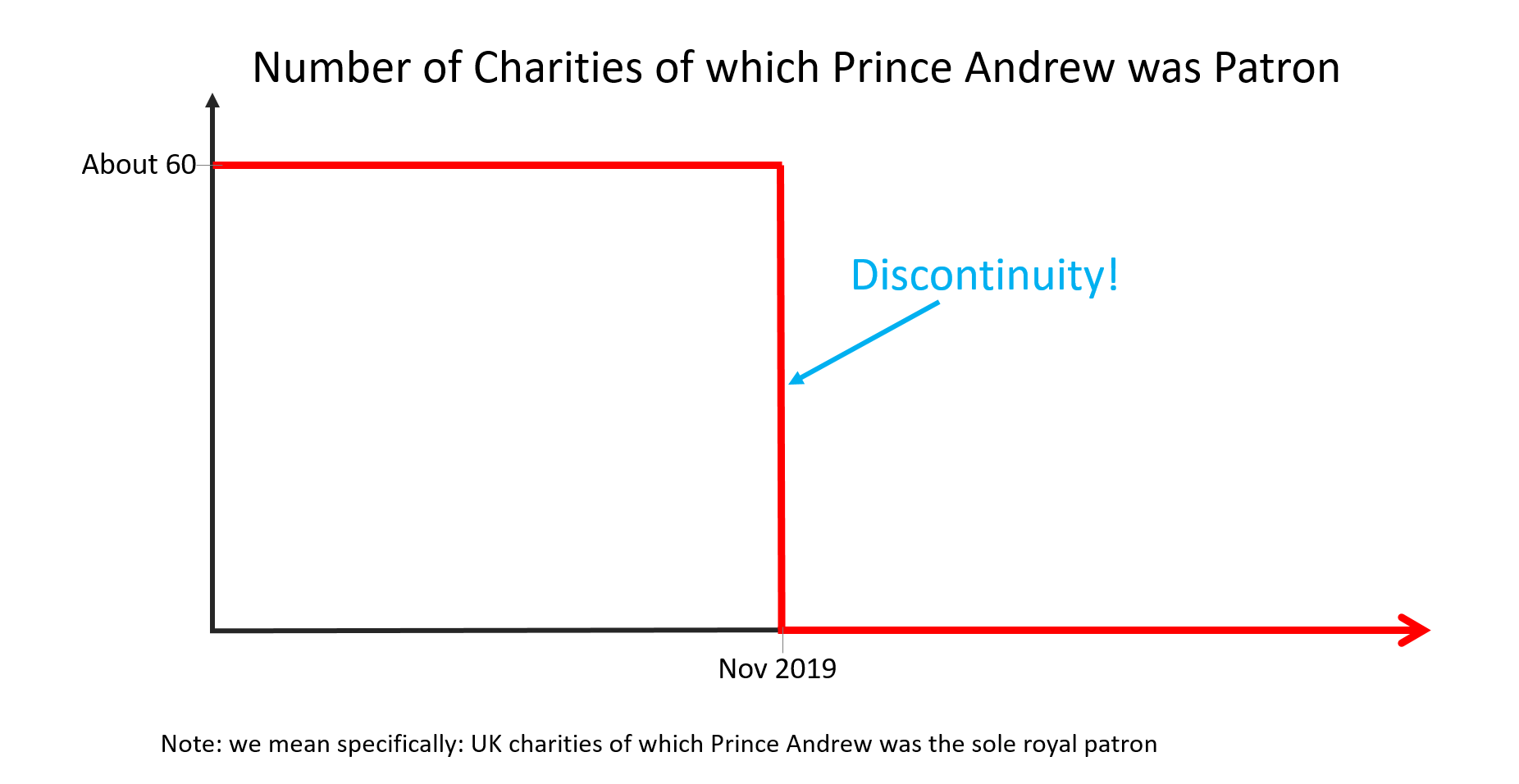
Prince Andrew “stepped back” from all public duties after his Newsnight interview in November 2019. That meant that all of his ~60 charity patronages ended at once (see graph). That creates an opportunity for analysis: in the language of statistics, that ending is a ‘discontinuity’ experienced by multiple entities simultaneously. We plan to analyse that discontinuity to find the effect of Prince Andrew’s patronages ending, and thereby what the effect of his patronages was.
In other words, now is the first point that enough ‘after’ data are available for this analysis to be possible.
Giving Evidence is unusually well-placed for this work, because we have the list of charities of which Prince Andrew was patron. Before the late Queen died (in September 2022), the British royal family’s website, royal.uk, listed all royal patronages. Its data were incomplete and inaccurate but at least it existed. After the late Queen died, that list disappeared and is no longer available. But Giving Evidence has the list from our 2020 analysis.
Giving Evidence will look at Prince Andrew’s effect on charities’ revenues. For the previous analysis, we explored analyzing the effect of patronages on various outcome variables, such as charities’ reputations, staff morale, press mentions as well as revenue. In the end, revenue turned out to be the only one which was workable: the others are not reported publicly or measured in any consistent way – so there is no data-set to analyse – and/or the definitions are not clear (for example, with press mentions, one would need sentiment analysis to identify whether any mention was positive or negative, which was beyond the project’s resources). Charities’ revenue is a great outcome because it is reported in a consistent way and to a regulator, i.e., the reported figures are likely to be correct. The analysis will look at all UK charities: it compares the changes in revenue of Prince Andrew’s patronee charities before vs. after the patronages ended, with the changes in revenue of all other charities at that time. This ‘difference-in-difference’ method is a standard way of assessing the effects of ‘interventions’ which cannot be randomised. (In effect, the patronage is/was an intervention in the life of a charity, and we are trying to identify its effectiveness.)
Our previous analysis looked at the discontinuity when patronages started; this new analysis will look at the discontinuity when patronages ended. [Technical note: though we use the term ‘discontinuity’, because there is one, we may not use regression discontinuity design, but instead difference-in-difference and other methods.]
If you are a Royal or celebrity patron and would like to be involved, do get in touch. Equally, if you are a charity with a Royal or celebrity patron and would like to be involved, do get in touch.
Giving Evidence will do this as proper research. i.e., we will publish the method, data & analysis in full – as we did with our ground-breaking analysis of charities’ admin costs, our research for the Foundation Practice Rating, etc.
We are grateful to the Human Rights Fund for enabling this project.
__________
Background notes:
Prince Andrew is the second son of the late Queen Elizabeth II: so, until the birth of Prince Charles’ first child (Prince William), Prince Andrew was second in line to the British throne. He is the Duke of York and often referred to by that title.
Prince Andrew was patron of ~60 charities. (And also many other entities which are not charities, such as parts of the military – which we will not analyse.) Our analysis looks only at (patronages of) UK charities – because their accounts are reported to the same regulators; we also only look at charities where Prince Andrew was the sole royal patron – to avoid the confounding factor of other royal patrons.
Because our analysis will cover the period since Prince Andrew’s patronages ended (i.e., since November 2019), it includes the deaths of Prince Philip and the late Queen – in 2021 and 2022 respectively – and also Covid.
Our research refers to Members of the Royal Family (MRFs) by their actual name, e.g., Prince William. This is not out of disrespect but rather simply to be easier for the reader. First, people (especially non-UK readers) may not know who the Earl of Wessex is; and second, various MRFs changed title after Prince Philip and the late Queen died, so using their titles would be confusing. For instance, during the period which we will be discussing, “the Prince of Wales” has meant both Prince (now King) Charles and Prince William.
Also since the late Queen died, the royals have done / are doing a ‘review’ of all their patronages: some have been re-allocated to other MRFs. The royal family no longer publishes a list of who is patron of what(!) so it is not possible to get from them a definitive list of which of Prince Andrew’s charity patronages have been re-allocated. Giving Evidence has had to research those individually.

 giving-evidence.com