Interesting snippets

Some bits & bobs about evidence & effectiveness in giving. Updated as & when.

Anonymous giving seems to prompt higher donations from other people. So says this research, in Britain. We’d have expected the opposite, both intuitively and because of this research in the US. (Perhaps yet more evidence, as if it were needed, that giving in the US and the UK are totally dissimilar.)

How to increase giving without cost: lovely paper on RCTs of interventions to get people to give more, which use behavioural insights. For example, when people are writing their will, just saying that ‘many of our clients include charities in their will. Are there any causes which you’re passionate about?’ increased legacies by 200%. Paper contains trials of five such interventions, across workplace-giving, legacies, regular donations and elsewhere. By the UK Cabinet Office.

The real purpose of the scientific method is to make sure nature hasn’t misled you into thinking you know something you actually don’t know’- Robert M Pirsig, in Zen and the Art of Motorcycle Maintenance. Continue reading

Posted in Uncategorized | Leave a comment

What is decent evidence?

‘Evidence is not the plural of anecdote’, wags often say. Sure, but what is it?

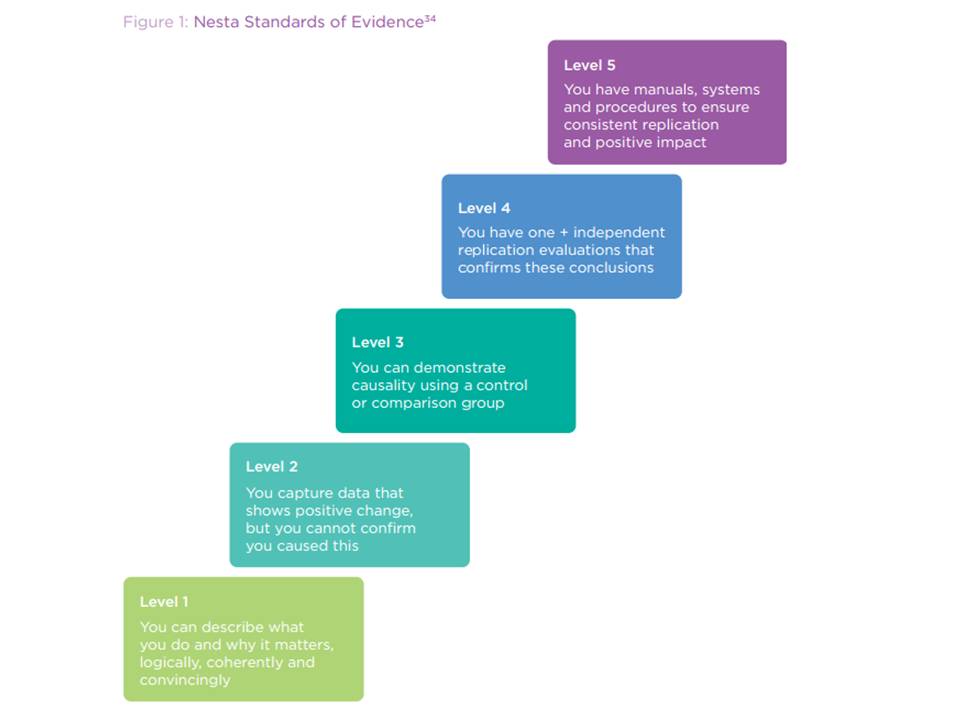
Evidence comes in many forms, some distinctly better than others. Below is a hierarchy produced by NESTA. Is it any good?

NESTA 2

Level 1 is essentially having a plausible theory of change. This is a rather odd inclusion on a hierarchy of evidence because it’s not evidence: it’s a story. Still, a coherent theory of change is (usually) necessary for effectiveness. Continue reading

Posted in Effective giving, Impact & evaluation | Tagged , , , | 7 Comments

What was it about 2003?

This seems to be the Year of Tenth Anniversaries of Good Things: evidently 2003 was a bumper year for setting up entities focused on improving philanthropy, charities and social enterprises. 

Happy tenth birthday to:

Innovations for Poverty Action: a global NGO which seeks to understand extreme poverty and identify what works, by doing randomised control trials (RCTs). It now has offices in 14 countries, and has done several hundred trials.

J-PAL, the network of development economists, based at MIT, which also does RCTs on poverty, and a close partner of IPA  (above).

The Skoll Centre for Social Entrepreneurship at Oxford University aims “to promote the advancement of social entrepreneurship worldwide”. Also this year is the tenth Skoll World Forum, which annually brings together leaders in social entrepreneurship in Oxford. (Giving Evidence’s Caroline Fiennes is speaking at it this year.) Continue reading

Posted in Uncategorized | Leave a comment

Don’t ask “what’s the impact of this charity?”

Longer article on this topic here—>

Posted in Effective giving, Impact & evaluation, Uncategorized | 2 Comments

What’s the point of corporate philanthropy?

This essay was first published by Ethical Corporation magazine

Climbing Borneo’s Mount Kinabalu is hard work. Climbers are legally required to hire a guide. Not that it always helps: guides sometimes just abandon the tourists and climb with each other. Why wouldn’t they? – there’ll be a fresh batch of tourists tomorrow who will be obliged to give them money. 

When I went up the mountain, I was lucky: the guides supporting my group stuck with us, even on our incompetently slow descent. They even missed their village football match for us. Why did they care?

Probably because I was travelling with Intrepid Travel, a global ‘adventure tour’ organiser which takes loads of groups to Borneo. Intrepid Travel has given generously to the guides’ village, supporting teaching programmes and providing learning resources. Clever: the villagers value their good relationship with Intrepid, and consequently the guides look after Intrepid’s clients assiduously.

Is Intrepid’s work in that village ‘charity’ or is it ‘investing in the business’? It’s both. Great corporate philanthropy always is. Continue reading

Posted in Corporate philanthropy, Effective giving | Leave a comment

Why ‘What’s Our Impact?’ is the Wrong Question

This article was first published by the Skoll World Forum and the Society of Impact Assessment Analysts

Since there are so many ways that charities and funders can use their finite resources, they must make choices: choices between competing goals (reduce homelessness or reduce child poverty), between competing approaches (reduce homelessness by providing more housing or by lobbying), and between competing target groups (provide more housing in Hull or in Halifax?)

So understanding the impact (or even potential impact[i]) of various programmes or organisations is fundamentally a comparative exercise. The important question is: ‘what does the impact and associated risk of Programme A relative to that of Programme B suggest about how we should allocate our limited resources?’

The normal question of ‘what is the impact of Programme A’ is pretty unhelpful. Often this question is in principle impossible to answer[ii], but even when it isn’t, it’s not helpful. Let’s suppose that Programme A is one whose impact is known: it’s an education programme whose effect is evident in children’s scores in year-end tests, and that it increases those scores by 10% on average. Let’s further suppose that we know the unit cost, which is £50 per child. (By the way, this is a great deal more clarity on impact than is normally available.) Continue reading

Posted in Effective giving, Impact & evaluation | Tagged , , , , , , , | 4 Comments

Why I’m delighted to join the Advisory Board of Evidence Aid

Boxing Day, 2004. You’re in Sri Lanka, and a tsunami has turned a beautiful day into utter devastation.Asian tsunami You’re a doctor and everywhere are ill people, injured people, distraught people: you’re also worried about epidemics of cholera, measles and so on. You know that some medical interventions will be better than others, and that some plausible-sounding ones may actually be harmful. You need a way to tell them apart. What do you do?

cochrane_logo

The medical profession is pretty organised about producing evidence on how effective an intervention is – even, often, on the relative effectiveness of different interventions. However, because the results of studies often conflict – some might show a small negative effect, some no effect, and others a strong positive effect – The Cochrane Collaboration was set up to produce rigorous objective summaries of all the evidence. So, as a doctor, The Cochrane Library (the go-to place for all Cochrane reviews) would be your first port of call. Continue reading

Posted in Great charities, Impact & evaluation | Tagged , , , , | 2 Comments

Influential charities you’ve never heard of: Index on Censorship

This was the last in an Advent Calendar for Spear’s Magazine of influential charities you’ve never heard of. It features Index on Censorship.

To the heart of the law

My cousin had a heart attack the week before Advent. He seems fine now, thank you, but I’d like to think that the treatments and medical implants he was given will prevent a recurrence. But in fact, they may not, they may even be counterproductive, not because of medical incompetence but because of an unhappy quirk of UK law. The final charity in our Advent Calendar is urgently straightening it out.

Dr Peter Wilmshurst, a cardiologist, designed and worked on a clinical trial to evaluate a heart implant made by NMT Medical, an American company. The trial found that the implant made little difference. When Dr Wilmshurst raised concerns about the trial in a medical conference and an academic journal – which you might think is a legitimate and important part of his job as a research scientist – NYT Medical sued him for libel. He had to spend over £100,000 of his own money and all his free time for more than three years defending himself and the right to discuss empirical scientific findings. Many other scientists would probably have given up: hence quite probably much literally vital information is hidden because of our libel laws. Continue reading

Posted in Great charities | 2 Comments

Influential charities you’ve never heard of: IPA

In the run-up to Christmas, Spear’s is highlighting four charities which we recommend you consider supporting. You’ve probably never heard of them, and that’s deliberate. This week is Innovations for Poverty Action, which researches how best to structure development and humanitarian projects, and then offers free advice and practical assistance to governments and NGOs.

3. Innovations for Poverty Action

Which of the following is the best way to prevent diarrhoea (a big and avoidable cause of death) in Kenyan villages: taking chlorine door-to-door so households can purify their water; putting in piped infrastructure at the water source for cleaner water; or giving chlorine to villagers at the source?

Well, before we put a load of money into any of those options, it would be a good idea to find out. This is what Innovations for Poverty Action does.

It researches the effectiveness of many programmes which aim to assist the world’s poorest people – including water and sanitation, health, education, finance, agriculture, environment and governance. Founded by a Yale University economist, IPA uses randomised control trials, the gold standard of rigorous experiments which are used in clinical drug trials.

The research is deliberately scientific: studies are led by leading researchers, many at universities such as Harvard, Yale, Massachusetts Institute of Technology and London School of Economics, and normally published in peer-reviewed journals.

This villager in Ghana is part of an experiment by IPA to research how to best help ‘ultra poor’ villages. The visitor is monitoring the progress of her and her family.

IPA has nearly 300 studies in over 40 countries with some surprising findings. For example, in the question above, the most cost effective programme is the last one – whereas most audiences guess the first.

It was IPA researchers who first figured out that microfinance wasn’t having all the effects which people claimed. And found that a great way of improving children’s learning – much cheaper than building more schools, hiring more teachers, or dishing out more books – is telling parents about the benefits to children’s later earnings which come from staying in school for a few more years.

IPA provides advice (for free) to governments and NGOs about its research findings to help them direct their resources towards the best programmes, and provides them with practical assistance.

The research itself is generally funded by academic sources, but private donations are necessary for the advice, for which demand is huge and growing as governments realise the value of heeding robust evidence. IPA also invites donations to its Proven Impact Initiative which supports the roll-out of some of the most effective work it has found, including some mentioned above.

Donations:

Can be made through https://poverty-action.org/donation_form (click on “Donate from the UK or Europe”)

Innovations for Poverty Action is a charity registered in the United States.

Week 4 in the Advent Calendar, featuring Halley’s Comet and Jesus –>

Posted in Great charities, Impact & evaluation, Uncategorized | 2 Comments

Influential charities you’ve never heard of: Beth Johnson Foundation

This Advent Calendar first appeared in Spears Magazine.

Just like investment opportunities, the best charities aren’t necessarily the ones which make most noise or which come to find you. So in the tradition of Advent calendars, each week this Advent philanthropy expert Caroline Fiennes will be showcasing one of the best charities you’ve never heard of.

2. The Beth Johnson Foundation

Active, social, respected and valued: we’d all like to be treated in our ‘senior years’ just as we like to be treated now. The Beth Johnson Foundation works to make that possible – for which it uses a remarkable model and with remarkable success.

It uses its very limited income to fund research and innovative thinking about the lives of older people. From that, it develops practical schemes which can improve older people’s lives and the wider community. It pilots those schemes, and if the pilot works, the foundation develops them with external partners and funders. Often, there’s eventually enough evidence and momentum for the schemes that they get adopted at local, national and international levels.

So the Beth Johnson Foundation is more like an R&D house and incubator than a classic charity, operating like a flywheel which spins out useful innovations.

Its impressive list of achievements includes: inventing ‘advocacy’ for older people, which ensures that the views of vulnerable older people are heard and heeded; pioneering work to help people in their 50s and 60s make changes to their lives to ensure a good future as they grow old; and programmes across the UK that bring young and old people to work and socialise together. This ‘intergenerational work’ is so popular that fully two thousand organisations seek the Beth Johnson Foundation’s free advice on it.

Donations
Donations by cheque should be made payable to The Beth Johnson Foundation and sent to The Beth Johnson Foundation, Parkfield House, 64 Princes Road, Hartshill, Stoke-on-Trent, ST4 7JL

To donate electronically or to set up a direct debit, e-mail admin@bjf.org.uk

The Beth Johnson Foundation is a Registered Charity 1122401

Week 3 in the Advent Calendar—>

Posted in Effective giving, Great charities, Uncategorized | 1 Comment