Application and reporting processes keep 3m children out of school

Avoidable waste from foundations’ reporting processes is ~£100m every year, enough to fund the whole of Barnardo’s or the British Red Cross. Another ~£150-250m is wasted in reporting to public sector funders, plus there’s plenty of avoidable waste in application processes. I’m pointing this out,  not because I hate foundations (I don’t) but because the obvious failure for beneficiaries means that it needs changing.

Charities address ‘problems that have resisted great intellects and often great money’ as Warren Buffett put it. Hence they need all the support they can get. Foundations and other funders should be using every penny to rapidly eradicating those problems. My new book is a guide for any donor to doing that: the figures above are from that, and, like all calculations used in the book, is public. The book opens with this quote from Clara Miller, Founder of the Nonprofit Finance Fund: ‘Deeply ingrained ‘best practices’ frequently add cost and reduce management flexibility in already difficult operating conditions. We end up hurting organizations we mean to help.’

Application processes

Let’s take a moment to understand the process most commonly used by major donors, because I want to dissuade anybody from copying it. It goes like this: define and publish some criteria for the types of charities you will support; design an application form;  invite applications; consider applications at infrequent, closed meetings at which a few charities are selected; give cash to those few; request periodic reports on paper.

Silent, solo, slow, reactive and unengaged, this process hardly looks like a recipe for achieving goals ‘which have resisted great intellects and often great money’.

Application forms are typically unique to each funder, yet generally request the same core data: name, charity number, list of trustees etc. So charities spend time (i.e., waste money) writing that information multiple times in multiple formats. How is that serving beneficiaries?

It isn’t. The various attempts by funders to create common application forms have failed. Yet it can’t be that hard: even eccentric and eclectic universities have had one for years. So I’ve unilaterally created one: it is here, and I suggest anybody uses it: it has the standard info at the front, followed by questions derived from the Standard Information Return (required of charities in England and Wales with income above £1m) and the ‘six questions which any which any charity should be able to answer’ from the book. If a funder wants to add questions, they can, but at least a charity can re-use the basic info without re-formatting it ad nauseaum.

In fact, many donors don’t need application processes at all. Many seek something which somebody else has already found, so should just use their recommendations. Independent analysts such as GiveWell make reliable recommendations, as do the randomised control trials merchants J-PAL or Innovations for Poverty Action. Other donors’ recommendations may suffice: when NatWest was looking for ‘community projects’ (dreadful term) for its CommunityForce programme, it could have just asked community foundations rather than creating its own (dreadful & wasteful) application process. Enlightened donors really do do this: Eurostar’s new award for sustainable transport uses the existing infrastructure in the Ashden Awards; a new donor I’m advising right now is giving their seven-figure sums to organisations which have already been selected by independent analysts and sound grant-makers; and of course community foundations route charities to donors to avoid multiple parallel selection processes.

Reporting

Companies report once a year. Their investors all see the same report, which is public, and share periodic conference calls.

By contrast, charities normally produce different reports for each ‘investor’ (funder), often each on different forms, which leads to masses of duplicated work. It’s excused because much funding is ‘restricted’ to a particular part of a charity’s activity, though in fact this practice is also fabulously damaging (it has no analogy in business). Furthermore, there is no ‘reporting season’ because normally reports are triggered by the managerially-irrelevant funding anniversary.

Charities’ costs of dealing with ‘investors’ are at least three times those for companies: 20-40% vs 7% for companies. Vanessa Kirsch, founder of New Profit Inc., a US venture philanthropy fund, laments that: ‘Non-profit CEOs spend huge amounts of time – sometimes as much as half their time – dealing with funders. What’s unfortunate here is that these leaders have incredible ideas about solving fundamentally important issues such as child literacy…but they can’t focus on their work because of the constant demands of funders’.

Funders often request reports for ‘accountability’: presumably as deterrent against fraud. It isn’t one: writing a form full of lies is not hard, and anyway, charities with significant revenue are audited to catch that.

Funders requesting bespoke reports is egregious and unnecessary: if you give on an unrestricted basis, the charity’s standard annual report for its entire operation will suffice and create zero marginal work.

The total cost of reporting by UK charities (to government and foundations) is estimated at around £1.4bn. Reporting to foundations – set up, and tax-payer subsidised to address ‘problems that have resisted great intellects and often great money’ – costs about £400m. On NPC’s conservative estimate, at least a quarter of that is avoidable, so foundations alone could save the sector £100m just on reporting – there’s masses to be gained by streamlining application processes too. [The calculation, like all those used in my book, is public, here.]

In developing countries, many children fail to get decent educations because they miss school because of having intestinal worms. Deworming (as it’s charmingly called) costs $40/child on an expensive estimate: often it’ll be as little as $4/child. The avoidable losses from reporting to charitable foundations would deworm and thereby keep in school – on a conservative estimate – 3m children.

What are we thinking of?

“Great advice for any donor”, James Caan, on this book about how donors best operate–>
Posted in Admin costs, Effective giving, Impact & evaluation | Tagged , , , , , , , , , , , , , , , , , , , , , , , | 4 Comments

WaterAid: what are you thinking of?

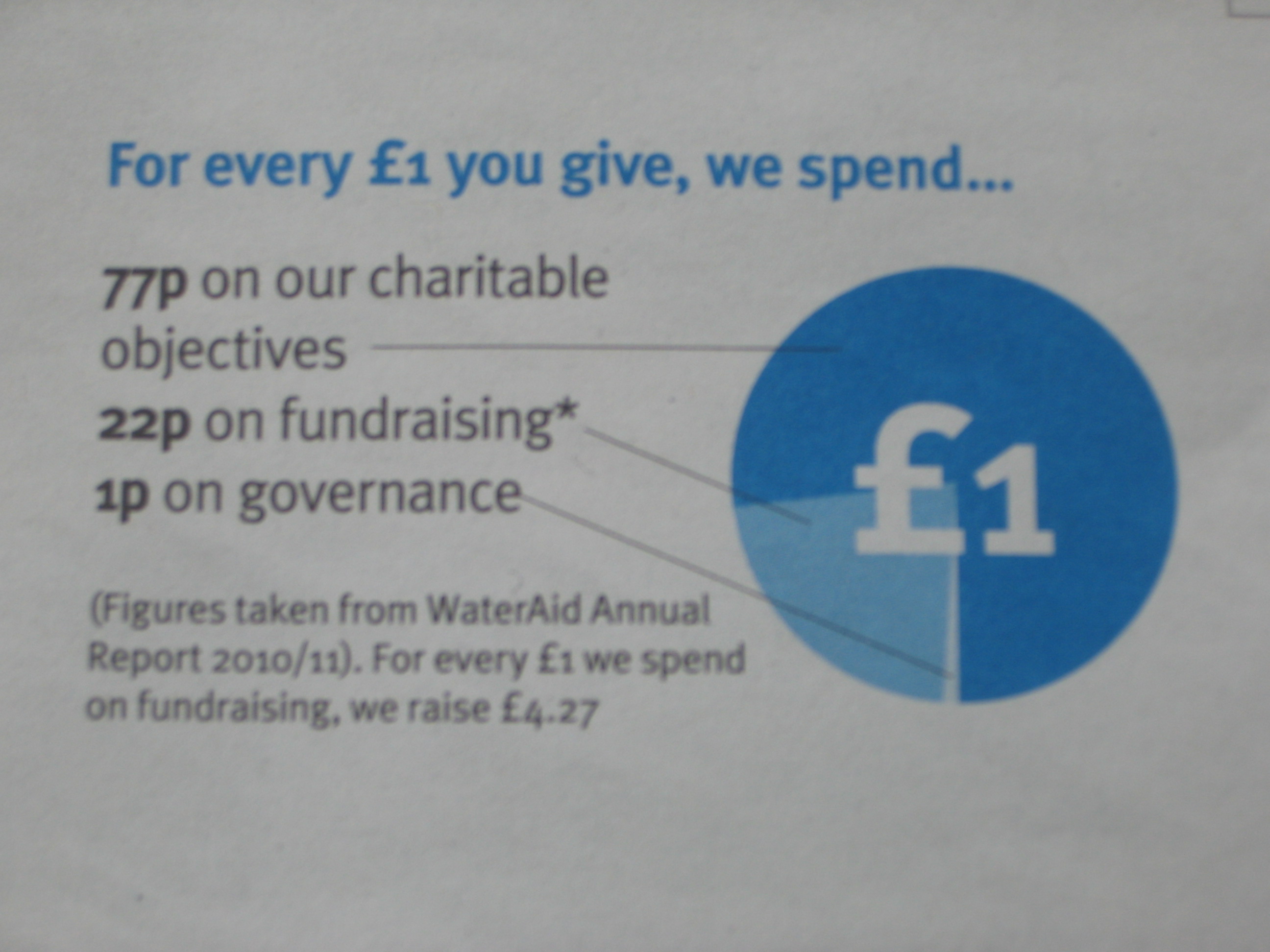
Millions of Thames Water customers have this week received leaflets from WaterAid containing this:

WaterAid should know better. This graph perpetuates the dangerous lie that charities’ spending on governance and fundraising is somehow separate from ‘work on charitable objectives’. They’re not: they’re integral to it.

First, what does this graph actually say? It states that 23% of WaterAid’s spending is not on its charitable objectives. Call the regulator: this seems to be admission of fraud or deception on a giant scale. The graph states that WaterAid’s fundraising and governance are not work ‘on our charitable objectives’: what do the trustees talk about if not its our ‘charitable objectives’? In a well-run charity every penny is spent in pursuit of the charitable objectives.

Second, why is this graph there? Presumably because WaterAid thinks potential donors will be impressed by how much of their money goes ‘to the actual cause’ and how little gets ‘wasted’ along the way. So WaterAid trains donors to think that a charity’s job is simply to ‘carry’ money from the donor to the beneficiary with minimal depletion. In fact, any decent charity will ADD value to donors’ money – through expertise, volunteers, economies of scale, partnerships, learnings from elsewhere, and so on. Many beneficiaries have been well-served by organisations doing R&D, or campaigning, or knowledge management, which may result in none of the money going ‘to the actual beneficiary’ and yet have massive impact. WaterAid’s graph makes it harder to raise funds for that type of work.

Third, it goes the wrong way. This graph – and others like it – implies that the less a charity spends on governance, the better. How wrong. Any decent organisation has great governance, and invests in it since it strengthens the organisation’s ability to serve beneficiaries. So, we learn from this graph that WaterAid doesn’t value its governance. It also seems to think its fundraising isn’t for ‘our charitable objectives’ – what is it raising money for then?

The evidence shows that the best charities spend more on both admin and fundraising than do the bad ones. So, by showing off the lowness of its spend on those items is, WaterAid is providing evidence that it’s no good.

The sole criterion on which donors should choose charities is their effectiveness. And the sole criterion which responsible charities encourage / educate donors to use is effectiveness.

WaterAid should grow up. In the interests of beneficiaries, many of are trying to guide donors towards being more effective, and graphs like these don’t help. The misinformation that efficiency = effectiveness makes life worse for beneficiaries by training donors to choose ineffective organisations.

Other myths about charities, and advice on giving well, in my book, here

How do you find out whether a charity is achieving anything?—>

Posted in Admin costs, Great charities | Tagged , , , , , , , , , , , , , , | 23 Comments

Who’s not applying themselves? Donors need to know

Writing and publishing a book which should improve charitable giving I figured made me a social entrepreneur. I needed money – all that editing and design doesn’t come cheap – so I approached UnLtd, the fund for social entrepreneurs set up with £100m left after the Millennium Commission and run by lots of McKinsey people.

I’d have to complete a form – you can imagine how much entrepreneurs love a form – to apply for a grant of up to £10k. The odds are reportedly about one in five, the average grant about £5k*, and the form pretty complicated. I’d need also to be interviewed and assessed … all occupying time which I could be spending actually doing my entrepreneurial work.

UnLtd’s killer question was how would I assess the impact of my ‘project’ (let’s come back to the term ‘project’). It’s a book! What kind of answer are you expecting? That I’ll do an annual survey of charitable giving, identifying changes over time, and doing some kind of regression analysis to circumscribe the book’s contribution to that? Or maybe I should do a randomised control test, to compare donors who read my book with those who didn’t and track their relative performance over time? UnLtd might supply £3k of the ~£12k it’ll cost, even before accounting for my time writing and organising publication, so UnLtd gets to ‘count’ a quarter of whatever impact that experiment identifies?

What rot. Answering the question with any sensible degree of rigour would require work and cost which dwarf that of creating the book itself. So I gave up and went elsewhere. Two private donors, each of whom I’d only met once obliged because the book is so obviously a good idea.

The story is salutary for several reasons. For one, Unltd will never know about entrepreneurs it fails to attract. Though it probably tracks its impact, I bet that only includes entrepreneurs it does support. There’s an outside chance that it considers the entrepreneurs who apply but are rejected – though very few donors even get that far. The ‘ones that got away’ – who were deterred before the process even started – are never considered.

This ‘silent witness’ is important because if a funder is ostensibly trying to support the best entrepreneurs in the land, it needs at least to find them. Yet UnLtd’s ‘help’desk didn’t even take my name, so they have no way of researching this silent constituency.

UnLtd is not alone in this. Donors of all descriptions should actively research the organisations which their processes fail to reach.  There’s a ‘selection bias’ even before the applications forms arrive. Usually these processes select (i.e., preclude everybody except) organisations which are able to discover that the funder exists (watch out if you’ve got no network), organisations able to complete forms (watch out if you’ve got poor literacy, bad English and/or no internet access), and also organisations and people who are well-enough connected to source their requirements from less bureaucratic sources.

So donors who are ambitious and hence passionately chasing the best uses of their resources, do well to consider the important silent witnesses who don’t register on their processes. A little research is required – and possibly just a little imagination.

Giving a goat as a present? Get an extra half-a-goat for free, like this—>

Posted in Admin costs, Donor behaviour & giving stats, Effective giving | Tagged , , , , , , , , , , , , , | Leave a comment

Charities should have open, public AGMs

A publicly listed company must hold a meeting at least annually which any shareholder can attend. Often press and industry analysts attend too. The directors account for their decisions and performance, and any shareholder can ask a question. Thus the company accounts to the  people whose money it is deploying and (therefore) whose interests it is ostensibly serving.

Why not charities too?

Charities must have ‘annual general meetings’ but these aren’t general at all: typically one of the normal, closed board meetings is designated as the AGM and nobody else knows it’s happening or is invited.

This is not good enough. Charities’ AGMs should be public for two strong reasons. First, for accountability to the people whose interests the charity serves, that is, to its beneficiaries. Most obviously, that means the people it serves now: if I were served badly by (taking a charity at random) Marie Curie Cancer Care, then the charity should account for that. More subtly, that those stakeholders also include people the charity isn’t serving but should. For instance, (I’m making this up for purposes of illustration), if cancer charities collectively underserve women, or people in the North West.

And second, because a good chunk of the money which charities deploy is the tax-payer’s – through tax relief on donations, reduced rates, zero corporation tax etc.  There is currently no mechanism for the tax-payer to hold them to account for that money. Let’s say that again: the tax-payer hands over billions of pounds with no assurance on quality or value for money at all, other than the famously light regulation by the Charity Commission et al.

So I propose that charities be made to have AGMs open to anybody, as a condition of receiving tax-payers’ money.

At these meetings, they should explain their goals, activities, how those activities are supposed to achieve those goals, their performance and achievements of the past 12-24 months, changes in the senior team, and plans for the next 12-24 months. Nothing that a competent organisation couldn’t do at a week’s notice.

They should be required to publicise the date and time in advance, and according to rules – just as there are rules for publicising public showings of art which belongs to the nation but lives in private property. For ease, I’d start with the top 450 charities, which any way account for nearly half the sector’s income.

Yes there will be costs. But shutting out beneficiaries, stakeholders and involuntary funders isn’t acceptable if you wish to be taken seriously.

How do you tell if a charity is any good? This book shows how–>

Posted in Tax and governance, Uncategorized | 5 Comments

The popular fetish of the small

The Economist this week has an article and data showing the folly of the popular affection for small companies. It shows that productivity* per employee is markedly higher in large companies than small ones for two reasons: employees in large companies get less distracted by being ‘asked to fix the boss’s laptop’ so can better focus on their actual job; and larger companies get economies of scale. Countries which encourage larger companies do better: Greece has loads more ‘micro’ firms (<10 employees) than does Germany. So, it argues, the public should shelve what it calls ‘the popular fetish of the small’.

Much of the logic applies to charities too. Larger charities get economies of scale: two charities of £500k revenue will pay two audit fees, whereas one of £1m will only pay one. And larger charities’ employees are (probably) better able to focus, making them better at their roles.

And yet donors of all types often prefer small charities. (Caroline has a letter in The Economist about this.) In England and Wales for example, fully 99.5% of charities have revenue below £10m; for companies, the definition of ‘large’ (i.e., bigger than SMEs) only starts at more than four times that, at £44m. Is that donor preference wrong?

Well, to have high impact, charities need good ideas and good implementation (which we could write as a formula: Impact = Idea x Implementation). Would you expect small (or large) charities to have a monopoly on good ideas? No. Some ideas are impossible without huge resources – managing chunks of coastline as the National Trust does might be an example – but not all: a local lunch club for elderly people or supporting people with a rare medical condition may not take much resource and can perfectly well be done by small organisations. Would you expect large (or small) charities to have consistently better implementation? No. Sometimes larger ones will be better, perhaps by deploying a large network of people, or getting economies of scale in purchasing, logistics and learning. But on the other hand, small charities may perform better by being more responsive and personal.


So what is wrong is to have a predilection based on organisational size, in the absence of any data about actual effectiveness.

Of course, analysing performance is much easier for companies than for charities. The Economist has a graph of employee productivity against company size. In the corporate world, measuring productivity is easy-peasy, but it’s harder/impossible for charities because their outputs aren’t financial. They’re often not quantifiable at all, and even where they are, they’re rarely readily interchangeable: the ‘units’ of education would be pretty different from those of preserved heritage. Revenue is no proxy for umpteen reasons including that charities legitimate use free labour which doesn’t need to be covered by revenue.

Nonetheless, donors can do better than make decision based on fetish.  A good start is to check whether a charity has a clear and important goal (=’idea’), clear theory of change which connects the charity’s activities with that goal, and growing set of data showing that it’s implementing it well.

Since charities address problems which, as Warren Buffett noted, have already ‘resisted great intellects and often great money,’ we owe it to beneficiaries to abandon childish tastes and fetishes and prejudices, and focus ruthlessly on what actually works – however surprising, small or large that might be.

Why don’t we shut up about business and use some different analogies for a change? We do here—>

Posted in Effective giving, Impact & evaluation, Uncategorized | Tagged , , , , , , , , , , , | 3 Comments

It Ain’t What You Give, It’s The Way That You Give It

It Ain’t What You Give, It’s The Way That You Give It: launches March 27th 2012

‘The Freakonomics of the charity world – but with better cartoons’  Martin Houghton-Brown, Chief Executive, Missing People

Great advice: inspiring, entertaining and much-needed’ – James Caan, Dragons’ Den panellist

‘A unique and very clear guide to a very complex topic, with insight for any donor’    – Body Shop International Values Director Paul McGreevy

“Caroline Fiennes explains how to balance heart and mind for serious philanthropy. She emphasises with clarity the importance of evidence and economics in order to maximise good deeds per dollar.”                       – Simon Singh, science writer

Whether you’re giving your own money, or raising money from somebody else, and whether you’re giving a lot or a little, this delightful guide is essential.’                           – Sir Ranulph Fiennes, the UK’s top celebrity fundraiser

Increasingly people see parallels between charity and business, so it’s refreshing and valuable that Caroline brings perspectives from elsewhere, including medicine, the military, politics, physics, history, genetics and psychology. A great read: any donor should read it and heed it.’ – Isabel Kelly, Int’l Director, Salesforce.com Foundation

Get a discount! For a limited period, the book is reduced from £16.01* to £12.99 from here:

It Ain’t What You Give, It’s The Way That You Give It is a guide to charitable giving – explaining how charities work, and giving advice about how best you can work with them to improve the world. It’s “exclusively for everyone” – relevant to you, your children, your hedge-fund-manager friend, big foundations, and corporate giving.

It includes advice on common situations:  how to choose a charity to put in your Will; whether to give anonymously, what is an intelligent response to a ‘chugger’ in the street, to being asked for sponsorship, to a request from your school or university.

It’s worth the effort: some charities achieve 25 times more with your money than others, and some ways of giving achieve 7 or 11 or 20 times as much with your donations. Using masses of examples and quirky stories, the book explains:

What you need to know about charities. For example: why are there so many of them, what they do in relation to government, the various ways that they improve the world, and how to understand their impact.

What you need to do. How to:

–          Find a good charity

–          Help it

–          Avoid hindering it

What to do if you’re giving a lot / as a family / in your company / as a foundation. For example, how to choose a focus area, how to get organised, the team you need, how to find a partner, how to track whether you’re being successful over time, and how to involve your colleagues.

The calculations used in the book are detailed here.

This is the Application form given in the book, which can be used by any donor.

Endorsements:

Body Shop International: “Caroline’s insight into a very complex topic provides a clear understanding to not only the complexities of charitable giving, but also a guide as to the impact of the donation. Donations are made to make a difference, they are a personal choice and often very generous,  but there is not always an understanding of the impact or lack of impact they may have. This book provides a very clear guide for any donor, from the novice to major corporate institutions. It’s unique to find this level of information in one place, and will create pause for thought for many people.” 

*Why the quirky price? It’s a nod to the Charitable Uses Act of 1601, which forms the basis of much charitable law in the UK and around the world.

Orders will be dispatched on or around the launch date.

Which bank is running one of the worst giving programmes we’ve ever seen? –>

Posted in Books, Effective giving, Uncategorized | Tagged , , , , , , , , , , , , | Leave a comment

Government fund scores new low for charitable funding

Forty three failures for every success. Is the government’s Social Action Fund – which ostensibly helps charities – trying to challenge the National Lottery for startling low probabilities? It would be funny if only it weren’t tragic and irresponsible. And public money.

The Cabinet Office set up and funds the Social Action Fund to “inspire new social action opportunities, encouraging people to give what they have: time, money, assets, knowledge or skills”. In its first round, it received 700 applications of which it supported just 16. Put another way, it rejected 684, that is, 98% of applicants – only one in 44 applicants. For each of those 16 ‘winners’, forty three other organisations wasted time finding out about the fund, understanding its guidelines and writing an application.

Such a giant rejection rate is, happily, rare. It beats even the current worst case, NatWest’s CommunityForce programme which last year rejected 93% of applicants. Amazingly, the government has just given another £10m to the organisation which distributes the Social Action Fund, called the Social Investment Business.

It’s tragic because all that time spent on unsuccessful applications could have been spent productively. For example, on ‘encouraging people to give what they have’ or indeed on solving social and environmental problems. That time is an opportunity cost: something good might have happened but didn’t because the time was used unproductively. And who bears that opportunity cost? The poor who don’t get served, the school-children or isolated elderly who don’t get supported, and ultimately all of us because our society doesn’t get fixed. The cost isn’t borne by the funder – indeed the funder may not see it or even realise that it’s there. But the cost is real, and since it was created by the funder, is what economists call a negative externality: a problem dumped onto somebody else.

But is the funder responsible if loads of charities apply? Yes. Because any funder which invites applications writes the guidelines: too general or unclear and they’ll generate tons of applications, many more than they need. BBC Children in Need is actively managing this ‘externality’: its Strategy Director Sheila-Jane Malley says: ‘We’re painfully aware that every application which doesn’t get through was work for somebody. As a responsible organisation interested in children, we’ve begun to look systematically at how we can prevent as much of that work as possible.’ It currently rejects three charities for each one it supports (pretty mild against the numbers above), and clarifying its guidelines precisely to prevent inappropriate applicants in order to reduce its rejection rate. It’s aiming for just one rejection per successful applicant.

Even more irresponsible than being vague is actively soliciting loads more applications than you need, which NatWest’s CommunityForce did. Presumably aiming to get its ‘benevolence’ as widely known as possible, it had a sizable PR drive to get applicants each of which had to gather votes from the public. A responsible funder would decide what it wanted to support and minimise the work it creates in finding it.

Both the Social Action Fund and NatWest’s CommunityForce invited applications. It’s a common device, which necessarily creates work because funders seem to keen to have bespoke application processes. If there were some sensible clearing house for applications – as there is for university applicants, say – or even just a common application form, all of this unnecessary, funder-instigated cost could be greatly reduced. Since the avoidable waste from duplicate application processes is estimated at £250m every year, that would produce more social action than any Cabinet Office fund.

NatWest’s programme commits many other sins—>

Posted in Admin costs, Uncategorized | Tagged , , , , , , , , , , , , , | 1 Comment

Why it’s irresponsible to insist that trustees are unpaid

It’s rather trendy to suggest that the work of the voluntary (charity) sector is enhanced by the fact that trustees are unpaid. It’s bulls**t. You can tell by asking the simple question by which most important questions in this sector can be resolved:

What would* the beneficiaries want? Put another way, what serves beneficiaries best?

The beneficiary’s perspective is the only one which matters. Let’s consider a child in India who can’t go to school. Would they rather be served by:

  1. People who have taken the time to understand the barriers they face to going to school, and to study the data about the relative effectiveness of various approaches. [Bear in mind that approaches differ wildly in their cost effectiveness. Some ways of purifying water, for instance, achieve twice as much as other ways. And some ways of ‘solving’ social problems actually exacerbate them.] People who may have worked with these kinds of problems before and/or in India or similar situations. Or
  2. People who haven’t but who are giving their time for free?

Warren Buffett had it right when he said that the problems which philanthropy seeks to solve “have already resisted great intellects and often great money.” They’re hard. Too hard to be left to well-meaning people who don’t actually understand. And too important too: these aren’t parlour games, they are literally matters of life or death – or joy or desperation – for other, real people. Understanding these problems takes time, and most people need to be paid for their time in order to live.

So if we don’t pay trustees, we end up with charities attempting to solve the most important and difficult problems of our complex world who are either:

–          Ignorant, or

–          Too rich to need an income.

Hmm. Hard to imagine beneficiaries voluntarily choosing either of chose over people who actually know what they’re talking about.

‘Ah’, the counterargument goes, ‘but think of all the money that would be spent if trustees were paid’. Yes, but I can also think about the giant amount of money which gets mis-spent because trustees don’t know what they’re talking about, and I can imagine (indeed, I could probably pretty easily prove) that the latter vastly exceeds the former. A false economy, as the economists say.

And a bizarre one. Nobody thinks that MPs should be unpaid, or teachers, or doctors, or the non-executives members of boards of government departments or entities like the Care Quality Commission or the Financial Services Authority. These all operate ‘in the public interest’, as do charities, so the difference is hard to explain (other than by reference to history, which is essentially spurious).

Other pernicious effects follow from trustees being unpaid. First, the charity’s chief executive can’t be a board member. This is just ridiculous. The CEO – who may even have founded the organisation and works on it all day every day – reports to a bunch of people who don’t even have this on their CV. They have no disincentive against making dismal decisions – like firing the CEO. They can be as capricious as they like: and often are. Second, trustee attendance at meetings is really patchy, because any paid work has to take precedence. Not because the trustees are evil or uncommitted, but because that’s how the world is. I used to have a lovely trustee who was a barrister – and guess what often happened when a client called him with a problem half an hour before one of our meetings? It’s simply unreasonable – the point of foolishness – to expect the unpaid to be as committed. Third, it’s harder to get rid of a trustee who’s rubbish. If that’s hard to see, think of it the other way: it’s easier to get rid of somebody if you’re paying them because they’re obviously wasting money.

So charity boards end up with ignorant and/or rich people who don’t turn up, and may be rubbish when they do come. And we entrust some of the most shameful and delicate problems known to man to that? Small wonder the problems persist.

____________

*That this question is stated as ‘would’ is interesting of itself. Beneficiaries rarely get asked. Sure, good charities involve ‘service users’ in the design of their services, but they rarely (never?) get asked about the more fundamental questions about how they are served. Where do they collectively think that funders should focus? Where do they collectively think that any particular funder should focus? What do they think about restricted funding? (clearly they might need the implications explained – as do many funders) Given that beneficiaries are ostensibly central to charities’ entire enterprise, their voice is conspicuously lacking.

Posted in Tax and governance | 2 Comments

What if etiquette and impact collide?

Perhaps it’s an occupational hazard. A friend or acquaintance asks for some advice or help with their charity. I’d like to help that friend… but the work or structure of the charity raises the alarm in my head. On one hand, I’m not helping a charity with those alarms unanswered, but on the other, to put my pal through the scrutiny which is warranted would be just rude because the concerns are so numerous and so profound. What to do?

Sometimes these alarm bells are really very serious, because I genuinely suspect that the charity could be doing a better job. And doing a less-good-than-is-possible job means children not getting educated, families not getting fed or housed, people not getting jobs – the ‘opportunity cost’ as economists dryly say is very significant for some real people somewhere. (This example is just one, in which a programme helps 1 child when it could have helped 25, meaning that fully 24 miss out each time. Huge.) Worse, some charitable programmes exacerbate the problems they’re trying to solve. Programmes have been found which increase vulnerable people’s chances of leaving school, or which increase susceptibility to disease. As a result, it’s simply not an option to applaud my friend’s good intentions.

Here’s an actual example, anonymised a bit. A senior ‘friend’ is involved in a UK-based charity which does health-work in West Africa. Great. Really? Well, I noticed that:

–  The board. There’s only person there who seems to have experience of West Africa. (And even that might not help: it’s a pretty heterogeneous place.) The others are all marvellous senior Western business people whose experience looks pretty irrelevant. The dynamics which keep poor countries poor, and which keep poor people poor are way too complicated for amateurs with essentially zero relevant experience. If I sound angry, it’s because I am.

–  The work. Is ‘delivering services’. Not building local skills and infrastructure? Why is western charitable money running hospitals, rather than (e.g.) training local staff and pushing for better provision by the indigenous governments? Again, the dynamics which keep poor countries poor do not get resolved by Westerners providing things which could be delivered locally. Indeed they may be exacerbated by it, that is, the charity may make things worse.

–  The theory of change itself. There really are better approaches than that used by this charity, as decent randomised control trials (RCTs) have shown.

All of which suggests that my friend’s efforts might, at best, not be producing as much as they could, and at worst, might be deepening the problem. So, er, that implies a moral responsibility to put the concerns to the friend.

Perhaps the answer is to select the most important alarm bell, and raise that issue diplomatically. ‘Oh great… how does the RCT data for that approach compare to the data for XYZ intervention?’ – a question to which they almost certainly won’t know the answer but might prompt them to look. But the trouble with that is twofold. First, people who are a couple of years into a programme are rather unlikely to be instantaneously persuaded to change it by some cold data. And second, they may anyway have restricted funding (that great scandal) which essentially compels them to continue.

‘When the facts change, I change my mind. What do you do sir?’

‘I might change my mind, sir, but I can’t change my work, for my funding is restricted and won’t allow it.’

While we can all objectively see the merit of evidence,  its implications may be shockingly profound and challenging, to the point of being rude. I’m genuinely interested in how other people deal with these situations.

Posted in Impact & evaluation | Tagged , , , , , , , , , , , , | 1 Comment

Who should be Chair of the Charity Commission?

Dame Suzi Leather is standing down, so naturally we get to vote on who replaces her.

Actually we don’t, but you can nominate people & we can all vote: right here.

It needs to be somebody who:

– REALLY understands how charities actually work. And how funder work. And how government works

– can tell government and charities and funders when to get off

–  is media-friendly

– has a high tolerance for boring meetings

– can run an organisation.

Not a huge field is it? My suggestions would include:

– Stephen Lloyd, senior partner at lawyers Bates, Wells & Braithwaite. Universally known, respected & admired. Practically wrote UK charity law. Presumably isn’t going to stay at BWB forever. (And, as Ben Goldacre said of Sir Michael Scholar, “he’s pretty unf**kwithable”.)

– John Kingston, founder of CAF Venturesome, Chair of the Association of Charitable Foundations. Who’s just kind of retired, but he’s way too good to be allowed to play golf all day.

– Tom Hughes-Hallett, who’s standing down as CEO of Marie Curie Cancer Care later this year. He’s got masses of experience of Big Ships (he was a senior banker before switching to cancer), and also of dealing with government. Nobody’d mess with him.

–  Halcolm Hayday,  who’s standing down as CEO of Charity Bank after 19 years at the helm. Running a trouble-free, innovative bank must be pretty tricky and he’s probably got a charity network to die for.

– Sir Gus O’Donnell. He must be looking for something to do right now…

That list is all white blokes who are 50+ which is rubbish. At least they’re not hedge-fund-managers-turned-Tory-party-donors.

Other ideas?

Posted in Tax and governance, Uncategorized | 1 Comment